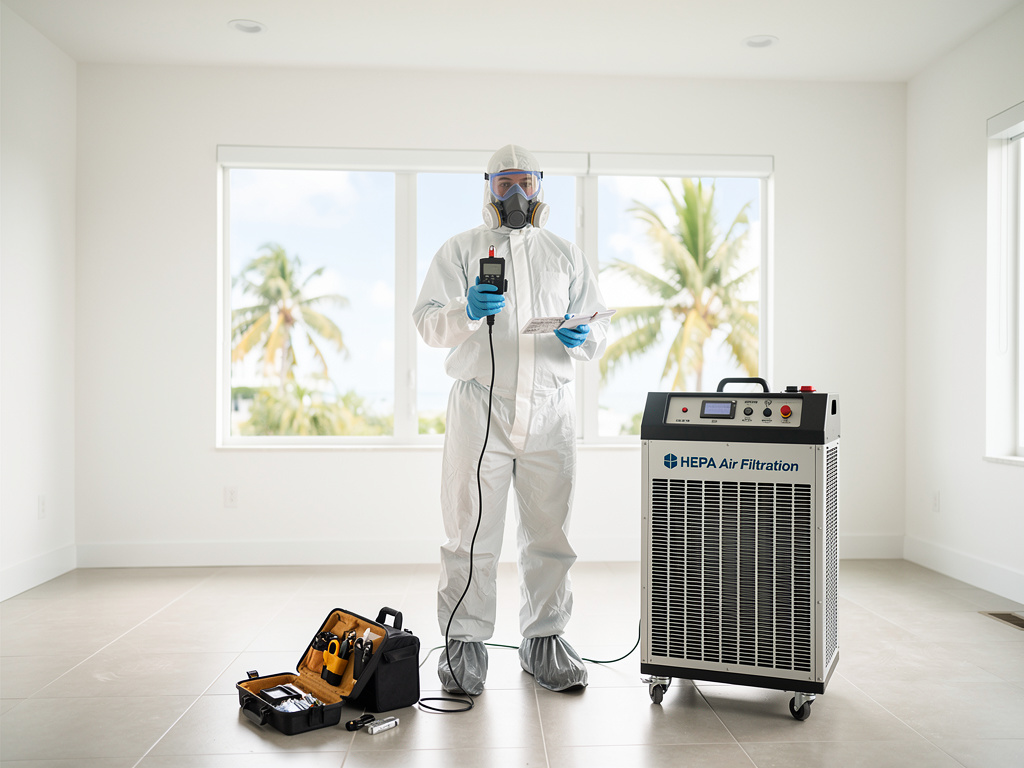
The Role of Mold Inspection and Testing in Miami’s Climate
Miami’s unique subtropical climate creates an environment where mold thrives year-round, presenting challenges that standard national mold inspection protocols often fail to address. Our team at Miami Mold Remediation Pros has firsthand experience with how elevated outdoor spore counts and the city’s high humidity affect mold detection and remediation. Unlike many parts of the country where mold season is limited to a few months, Miami’s consistently warm and moist conditions mean homeowners face persistent mold risks. Understanding the role of mold inspection and testing specifically tailored to Miami’s climate is essential for accurate diagnosis and effective cleanup, especially in sensitive oceanfront neighborhoods like Surfside and Bal Harbour where sea air introduces additional complexities.
In Miami’s climate, mold inspection and testing must account for naturally high outdoor spore levels and persistent humidity, which standard protocols often overlook. We recommend baseline indoor-outdoor spore comparisons tailored to local conditions and follow-up testing after major wet season rains to ensure remediation success.
Why Standard National Mold Inspection Protocols Underserve Miami Homeowners
Most national mold inspection standards are designed around climates with distinct mold seasons and lower ambient spore levels outdoors. These protocols often assume that outdoor spore counts drop significantly during colder months, which helps establish a clear baseline for indoor comparisons. However, Miami’s subtropical climate features year-round warmth and humidity, resulting in consistently elevated outdoor mold spore counts. This constant high baseline challenges inspectors who rely on typical indoor vs. outdoor spore count comparisons to determine contamination levels inside homes.
Additionally, standard protocols do not always factor in Miami’s frequent rain events, which can cause rapid fluctuations in indoor moisture levels and mold growth potential. Homeowners following generic national guidelines may be misled by initial clearance tests conducted during drier months, only to experience mold recurrence during the wet season. Our team emphasizes the need for Miami-specific inspection approaches that reflect these unique environmental factors, ensuring more accurate assessments and effective remediation plans.
Understanding Elevated Year-Round Outdoor Spore Counts in Miami-Dade and Their Impact on Clearance Testing
In Miami-Dade County, outdoor mold spore concentrations remain elevated throughout the year due to the warm, humid climate and dense vegetation. Unlike temperate regions where outdoor spores drop in winter, Miami’s outdoor environment consistently produces a high baseline of airborne spores. For mold inspectors, this means that standard clearance testing thresholds—designed for lower outdoor spore counts—may falsely indicate indoor mold problems or clearance failures.
Effective clearance testing in Miami requires establishing a localized baseline by measuring outdoor spore populations contemporaneously with indoor samples. Our experience shows that indoor spore counts slightly exceeding outdoor levels can still represent a clean environment in local terms. Clearance standards must be calibrated to these Miami-specific baselines rather than relying on generic national thresholds.
Without this adjustment, homeowners risk unnecessary remediation or false assurances of mold removal. This is why our mold inspection testing in Miami includes detailed spore type analysis and contextual interpretation to accurately determine whether indoor mold growth persists post-remediation.
Why a ‘Clean’ Post-Remediation Test in December May Not Hold Through August
Many Miami homeowners schedule mold remediation and clearance testing during the drier months, such as December. While this timing can make initial mold removal easier, it does not guarantee lasting results. Miami’s wet season, typically starting in June and continuing through September, brings heavy rains and elevated humidity that can trigger mold regrowth if moisture sources remain unchecked.
A clearance test conducted in December may show spore counts within acceptable limits, but without follow-up during or after the first major rains, hidden moisture issues can cause mold to return undetected. This seasonal variation stresses the importance of follow-up testing and ongoing moisture monitoring during Miami’s wet season.
Our team advises homeowners to plan initial remediation early in the dry season but to schedule follow-up inspections and testing after the first significant rainfall. This approach helps verify the long-term effectiveness of remediation efforts and prevents costly mold recurrence.
Best Practices for Follow-Up Testing After the First Major Rain of Miami’s Wet Season
After completing mold remediation and achieving clearance testing during the dry season, the first major rain event of Miami’s wet season acts as a critical stress test for moisture control and mold prevention. Our team recommends scheduling follow-up mold inspection and testing within one to two weeks after this rain to detect any signs of mold resurgence early.
- Inspect moisture-prone areas: Pay special attention to basements, crawl spaces, window frames, and HVAC systems where water intrusion is most likely.
- Conduct spore sampling: Compare indoor air spore counts to outdoor levels after the rain to identify any spikes indicating new mold growth.
- Evaluate building envelope integrity: Check seals, gutters, and drainage systems to prevent water accumulation.
- Update remediation plans: If mold is detected, adjust remediation strategies promptly to address newly identified issues.
This proactive approach ensures that mold problems in Miami homes do not go unnoticed during the high-risk wet months, enhancing long-term indoor air quality and resident health.
Special Considerations for Surfside and Bal Harbour Oceanfront Buildings: Sea Air and Mold Complexity
Oceanfront neighborhoods like Surfside and Bal Harbour present unique challenges for mold inspection and testing due to the constant presence of salty sea air combined with Miami’s humid climate. Salt particles can interact with building materials and moisture, creating microenvironments that promote specific types of mold growth not commonly found inland.
Our team has extensive experience working in these oceanfront communities, where corrosion, moisture retention, and salt residue complicate mold detection and remediation. Standard mold inspection protocols often overlook these factors, leading to incomplete assessments.
Key considerations include:
- Corrosion impact: Salt air accelerates metal deterioration in HVAC and plumbing systems, increasing moisture leaks and mold risk.
- Surface sampling: We incorporate surface testing alongside air sampling to detect mold colonies growing on salt-affected surfaces.
- Customized remediation: Treatments must address both mold and salt residue to prevent recurrent issues.
- Building maintenance coordination: Collaboration with property managers ensures regular sealing, ventilation, and cleaning tailored to oceanfront conditions.
By adapting our mold inspection testing to account for these oceanfront environmental factors, we help Surfside and Bal Harbour property owners maintain healthier indoor environments despite the complexities of sea air exposure.
Frequently Asked Questions
Contact Miami Mold Remediation Pros
If you’re concerned about mold in your Miami home, don’t wait to get a professional inspection. Call Miami Mold Remediation Pros today at (645) 241-5434 to schedule your consultation and protect your indoor air quality.
Miami Mold Remediation Pros
📍 4300 Biscayne Blvd STE 203, Miami FL
📞 (645) 241-5434
🌐 https://miamimoldremediation.us